
2026-05-26
Why Your Brain Needs Daily Affirmations (And Not Just the 'Good Vibes' Kind)
Research shows self-affirmations do more than boost mood - they change how women respond to stress, fight negative self-talk, and actually follow through on wellness goals.
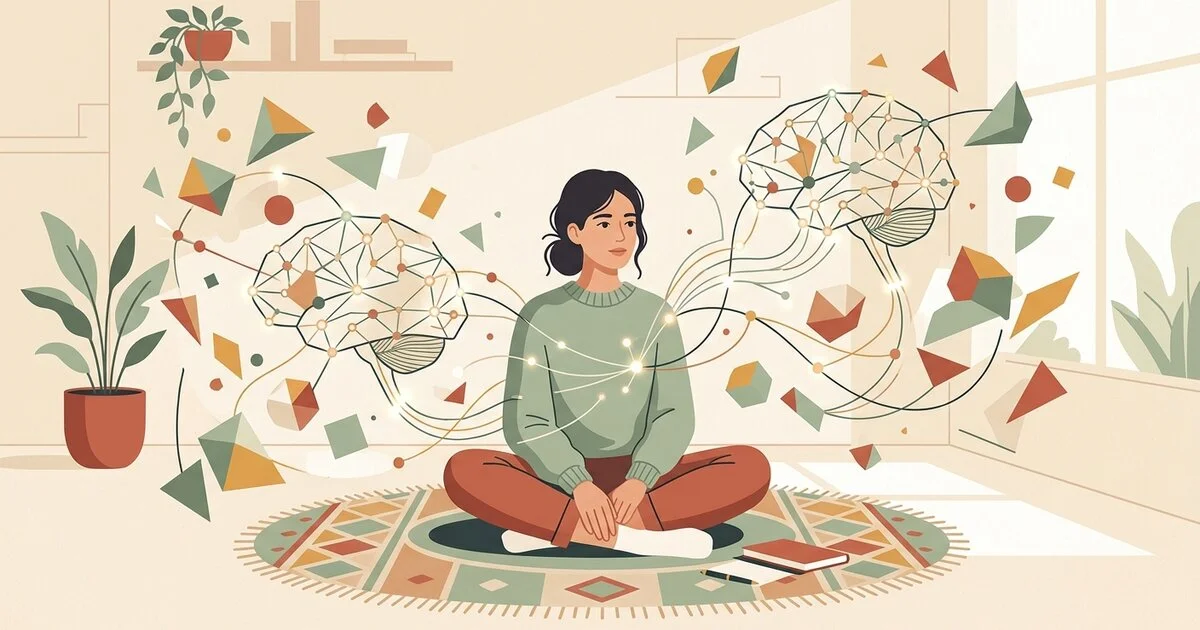
That inner voice running through your head right now . is it kind?
For most women, the answer is no. Most days, that voice sounds less like a supportive friend and more like a relentless critic: Did I say the right thing? I should have handled that better. Why can't I just get it together?
You're not broken. And you're definitely not alone.
Women are nearly twice as likely as men to fall into rumination. Susan Nolen-Hoeksema at Stanford, whose work has been cited over 4,900 times, documented this pattern across thousands of participants. Rumination doesn't lead to resolution. It amplifies. A 20-minute spiral about a work mistake doesn't end with clarity . it ends with exhaustion and the same problem still sitting there unresolved.
It's not weakness. This is a cognitive pattern, and patterns can be changed.
What the Research Actually Shows
The word "affirmation" gets watered down constantly. But in psychology, self-affirmation theory has been tested rigorously. The core idea: when you consciously reinforce your core values and sense of self-worth, especially before or during stressful situations, you reduce defensive reactions and open yourself up to processing information more clearly.
A meta-analysis in APA's Review of General Psychology reviewed 144 experimental tests. The findings were striking. Self-affirmation produced reliable positive effects on message acceptance, intentions to change, and actual behavior change across health domains.
For women specifically, the results hold up. Studies on dietary behavior found that women who did a self-affirmation exercise ate about 5.5 more portions of fruits and vegetables over one week compared to a control group. Another review found that self-affirmation interventions increased the odds of women taking action on health goals . from cancer risk reduction to smoking cessation.
The effect size was modest (d = 0.17 for message acceptance, d = 0.32 for behavior change), but consistent. Think of it less like a magic spell and more like mental push-ups . small, repeated efforts that build real capacity over time.
Affirmations Aren't Denying Reality . They're Building Something
Here's where most people get it wrong. They treat affirmations as denial: I'm fine! Everything is great! I refuse to feel bad!
That's not what the research supports. Self-affirmation isn't pretending bad things aren't hard. It's creating a stable internal foundation so that when difficulty hits, you don't lose your sense of worth along with your composure.
The statement "I am stressed right now, and I can handle this" is a far more powerful affirmation than "I am not stressed." Acknowledgment + agency. That's the formula.
The most effective affirmations are value-based rather than outcome-based. Rather than "I will get the promotion," try "I am someone who shows up fully for the work that matters to me." One is dependent on external factors. The other is true right now, regardless of circumstances.
What Actual Women Say
The research tells us what works in controlled settings. Real women tell us what it actually feels like.
From a thread in r/Journaling, one woman shared: "I used to think affirmations were cheesy. Then I started saying them out loud in my car before walking into hard situations. It sounds ridiculous, but I genuinely feel like I can breathe first. Like I'm giving myself permission to show up as I am."
Another, from r/selfimprovement: "My therapist had me write down three things I value about myself when I'm spiraling. It sounds so small, but it breaks the loop. Instead of going deeper into the rabbit hole, I have a moment of 'wait, that's not all I am.'"
Both experiences have a key detail in common: the affirmation was used in context . before a hard moment, or during a spiral. Not as a generic morning ritual, but as an actual tool.
How to Build Something That Works
The research shows that three or more sessions produces greater effects than fewer. Consistency matters. But consistency doesn't mean rigid daily scripts that feel hollow.
Start with your values, not your goals. What qualities do you most want to embody . not achieve, but be? Compassion, curiosity, resilience, honesty? Your affirmations should reflect these, because they are always available to you, regardless of external outcomes.
Make them in your own voice. Hearing your own voice say something affirming activates different neural pathways than just reading it. When you record yourself saying your affirmations . and replay them . you're essentially having a conversation with your most grounded self. MyRuel's voice journaling feature makes this easy to do daily, and the playback function lets you return to your own words on hard days.
Use them when you need them, not just when you wake up. The research on self-affirmation effectiveness is strongest when the practice is deployed during or before stressful moments. Keep your affirmations accessible . in a notes app, on your bathroom mirror, or in a voice journal entry you can replay.
Be specific to your life. Generic affirmations like "I am amazing" often bounce off because they don't feel connected to your real experience. Try: "I am learning to set boundaries without guilt." That's true, it's yours, and it reminds you of a choice you're actively making.
One sentence, in your own voice, said with even a little bit of belief. Your brain will notice. And over time, so will you.
Ready to build an affirmation practice that actually sticks? MyRuel's voice journaling makes it easy to record, replay, and return to the affirmations that ground you. Download MyRuel and start your free today.