
2026-06-09
The Neuropsychology of Voice vs Pen: Why Speaking Activates More Brain Regions Than Writing
Writing and talking feel similar. Your brain disagrees. A 2006 study found that talking through experiences improved mood more than writing about them, and neuroscience explains why.
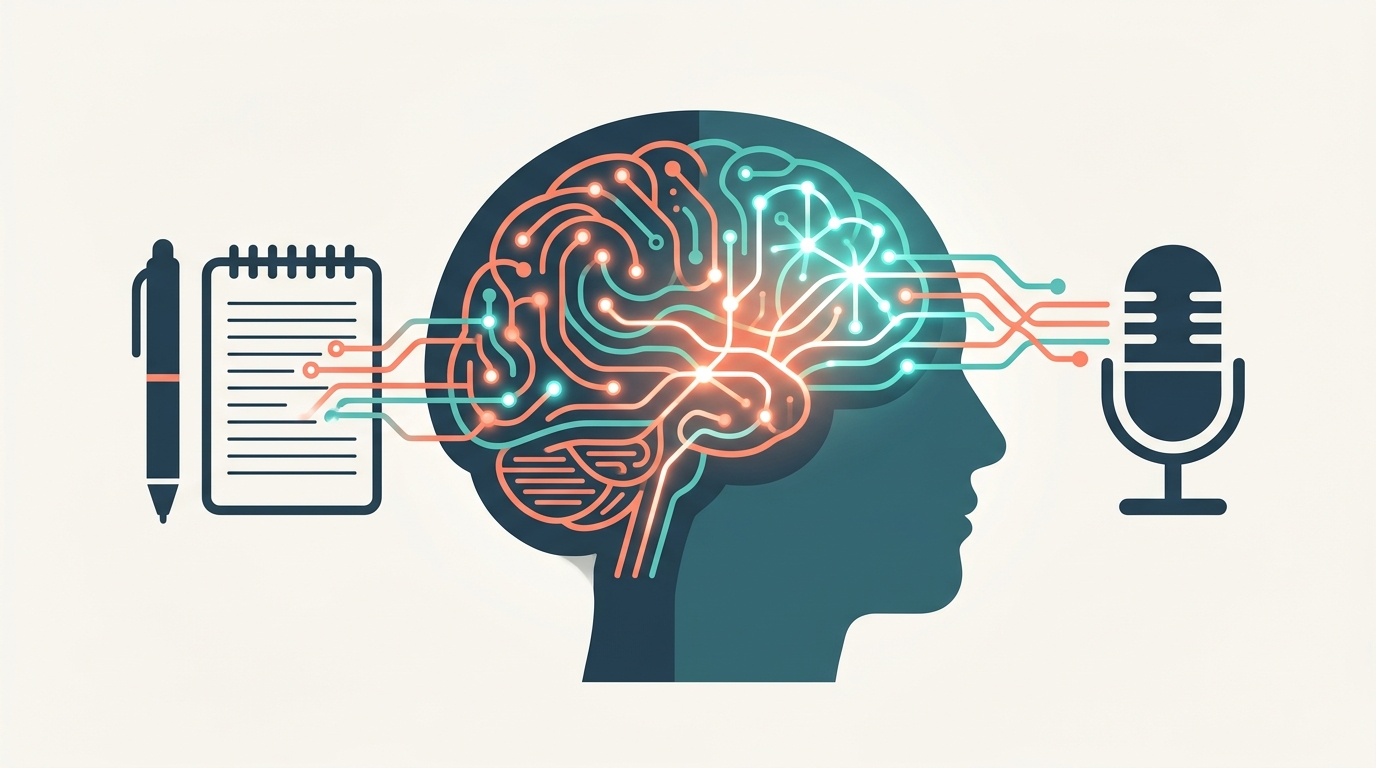
In 2006, psychologists Sonja Lyubomirsky, Lorie Sousa, and Rene Dickerhoof ran a simple experiment. They asked participants to write, talk into a recorder, or simply think about their happiest and worst experiences, fifteen minutes a day for three consecutive days.
The result wasn't close. Talking beat writing on measures of mood improvement and psychological well-being. Thinking came in last.
The researchers called it "the costs and benefits of writing, talking, and thinking." But the real question underneath was simpler: why does putting words in your mouth hit harder than putting them on a page?
Two different neural highways
Writing and speaking look similar on the surface. You're translating inner experience into language. But they travel through completely different parts of the brain.
Speaking pulls in motor regions that control your mouth and throat, auditory regions that process your own voice, and limbic system activity tied to emotional tone. When you talk, your brain treats your own voice like data. It hears the pitch, the rhythm, the hesitation, the quickening. That feedback loop doesn't exist when you write.
Writing, by contrast, routes through visual-motor areas, working memory, and fine motor control. You're translating thought into abstract symbols on a page. The emotional texture of what you're saying gets filtered out in the process because your brain is busy managing the mechanics of pen movement and spelling.
This is why you can cry talking and not cry writing. The same words, different neurological pathways, different emotional weight.
Broca and Wernicke don't equally fire for both
The classic language regions, Broca's area for production, Wernicke's for comprehension, activate for both speaking and writing. But that's not the whole story.
Speaking also lights up the supplementary motor area (involved in planning movement), the insula (tied to interoception, your sense of your own internal state), and the anterior cingulate cortex (which monitors conflict and emotion). Writing mostly stays in the language circuit plus the motor cortex.
In short: speaking engages more of your emotional and bodily self. Writing stays more in the abstract-symbolic domain. Neither is wrong, but they're not equivalent.
Prosody carries what words can't
When you write "I was angry," you compress the emotion into a noun. When you talk, you might say it with a tight jaw, a rising pitch, a sharp exhale. That prosodic layer, the music of speech, is data your brain processes as emotion information.
Research on emotional prosody shows that the brain processes vocal tone faster than semantic content. Your nervous system responds to how something is said before you've consciously processed what was said. Writing strips all of that out.
Voice journaling keeps the prosody. That's not a small thing.
The working memory angle
Writing is harder on working memory. You're holding the thought, monitoring the motor output (handwriting or typing), checking grammar and spelling, and trying to sound like yourself, all at the same time.
Talking is more fluid. The constraint is just: keep going. Your working memory can stay focused on the emotional content rather than managing the mechanics of output.
This is why people often feel they "can't write" but have no problem talking for twenty minutes. The issue isn't being articulate. It's cognitive load.
What the research actually says
Lyubomirsky's team found that participants who talked showed better mood outcomes than those who wrote, and this held across both positive and negative experiences. The talking group didn't produce better or more insightful content. They just talked, and the process itself did something writing didn't.
This fits with what we know about emotional processing: the act of externalizing through speech, hearing yourself, feeling the words leave your mouth, seems to complete something that writing leaves unfinished.
Your brain has been speaking for far longer than it's been writing. Language evolved as sound. Reading and writing are recent inventions layered on top of older machinery.
Voice journaling works with that machinery instead of against it.
Lyubomirsky, S., Sousa, L., & Dickerhoof, R. (2006). The costs and benefits of writing, talking, and thinking about life's triumphs and defeats. Journal of Personality and Social Psychology, 90(4), 692–708.