
2026-08-19
The Fixed Sentence
I caught it on a voice note last Tuesday. I was talking through a project I'd been avoiding, and out of my own mouth came the sentence I'd said a hundred times before: 'I'm just not good at this kind of thing.' I said it like it was a fact. Like my height, or my shoe size.
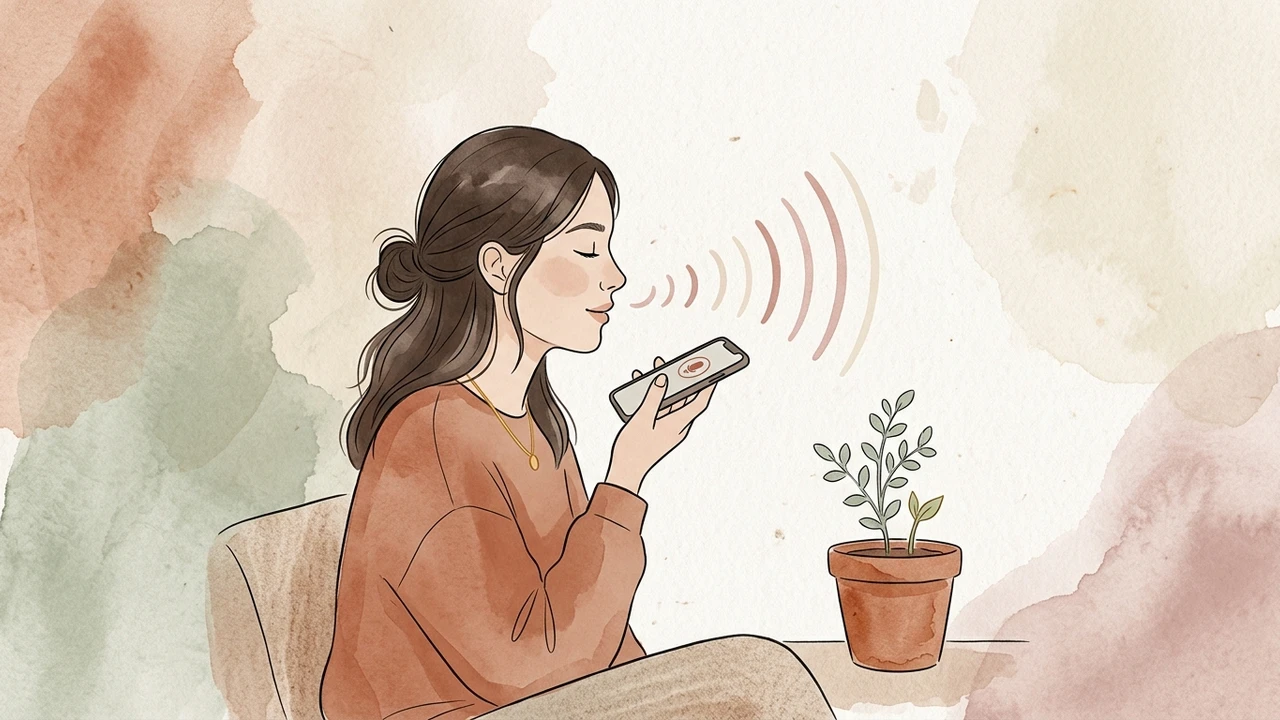
I caught it on a voice note last Tuesday. I was talking through a project I'd been avoiding, and out of my own mouth came the sentence I'd said a hundred times before: "I'm just not good at this kind of thing."
I said it like it was a fact. Like my height, or my shoe size.
The difference is, I heard it this time. That's the thing about speaking instead of writing. When I write that sentence in a notebook, it looks reasonable. It looks like self-awareness. When I say it out loud and play it back, it sounds like a door closing.
What a fixed sentence actually is
Psychologists have a name for the belief underneath it. Carol Dweck's work on mindsets, which she and David Yeager updated in a 2019 review in American Psychologist, draws the line like this: a fixed mindset treats ability as something you have or don't have, and a growth mindset treats it as something that develops with practice.
The 2019 version of the theory is more careful than the poster version. It's not "anyone can do anything." It's that the belief about ability shapes what you attempt, what you stick with, and what you hear when you fail. Dweck and Yeager are explicit that mindset is one factor among many, not a magic switch. But they also make a point I keep thinking about. The mindset isn't just in your head. It's in the sentences you say, to yourself and out loud.
The study that made me stop rolling my eyes
I rolled my eyes at growth mindset for years. It felt like a corporate training slide. Then Yeager and colleagues ran the study that changed my mind, published in Nature in 2019.
It was huge. 12,490 ninth graders across the US. Half got a short online program teaching that the brain grows with effort and that struggle is part of learning, not proof of failure. The other half got a placebo version.
The results were modest on average. That's the honest part. But for lower-achieving students, the ones most likely to believe they just weren't smart, the effect was real. Their grades went up, and the effect was biggest in schools where the environment reinforced the message. One short intervention didn't fix everything, but it shifted something measurable.
What stayed with me is how small the shift was. Not a personality overhaul. A slightly different interpretation of struggle, repeated until it stuck.
The anxiety version
There's a version of this that hits closer to home for me, because it's about anxiety, not grades.
Schroder and colleagues published a study in Personality and Individual Differences in 2017 on what they call a growth mindset of anxiety. The belief that anxiety is manageable, that it's a signal you can work with rather than a verdict on who you are. People who held that belief coped better with stressful life events. Same stress, different story about what the stress meant.
That maps onto a sentence I say constantly. "I'm an anxious person." Fixed. Versus "I'm having a lot of anxiety right now." Temporary, specific, workable. The first sentence is a life sentence. The second is weather.
Why saying it matters more than writing it
Here's where voice journaling earns its keep, at least for me.
Writing lets me polish. I can write "I'm learning this, it's a process" and it looks great on the page. But my voice doesn't lie the same way. When I say "I'm just not good at this," I hear whether I believe it. There's a flatness, a resignation, that doesn't exist in handwriting. And when I say the growth version out loud, I can hear the wobble. The wobble is honest. It tells me which sentence is true right now, not which one I want to be true.
So I started doing something small. When I catch a fixed sentence on a recording, I re-record it with "yet" added. "I'm just not good at this" becomes "I'm not good at this yet." One word. And I say it again until I stop flinching at it.
The first few times, the "yet" version sounded wrong in my own ears. Like a lie with good posture. I kept it anyway. And somewhere around the fifth or sixth repetition, the sentence stopped bouncing off me and started landing. That's the part I can't get from a thought. The thought just repeats. The spoken version has to pass through my throat, and passing through changes it.
It's not a magic trick. The research doesn't claim it is. Yeager's own paper is careful about that. But the evidence suggests the sentence matters, and the only way I can hear which sentence I'm actually saying is to say it out loud.
The honest limits
I still say fixed sentences. All the time. Last week I told my phone I'm "not a numbers person," which is a sentence I've been repeating since high school math, and it's never once been useful to me. The difference now is that I hear it when it happens. And hearing it is most of the battle, because a sentence you can hear is a sentence you can argue with. A sentence you only think is a fact you live under.
The other honest limit: changing the sentence doesn't change the situation. The project is still hard. The anxiety still shows up. What changes is what I do next. Fixed sentences make me avoid the thing. Growth sentences make me start it badly, which turns out to be the only way I've ever gotten better at anything. And that's the part I actually wanted all along.
So here's my question for you. What's the sentence you say about yourself that you've never actually heard out loud, and what would it sound like with "yet" on the end?