
2026-08-24
The Unsolvable Note
I have a voice note from March I've never listened to all the way through. I recorded it in my car, outside my mom's house, and I don't need to hear it again.
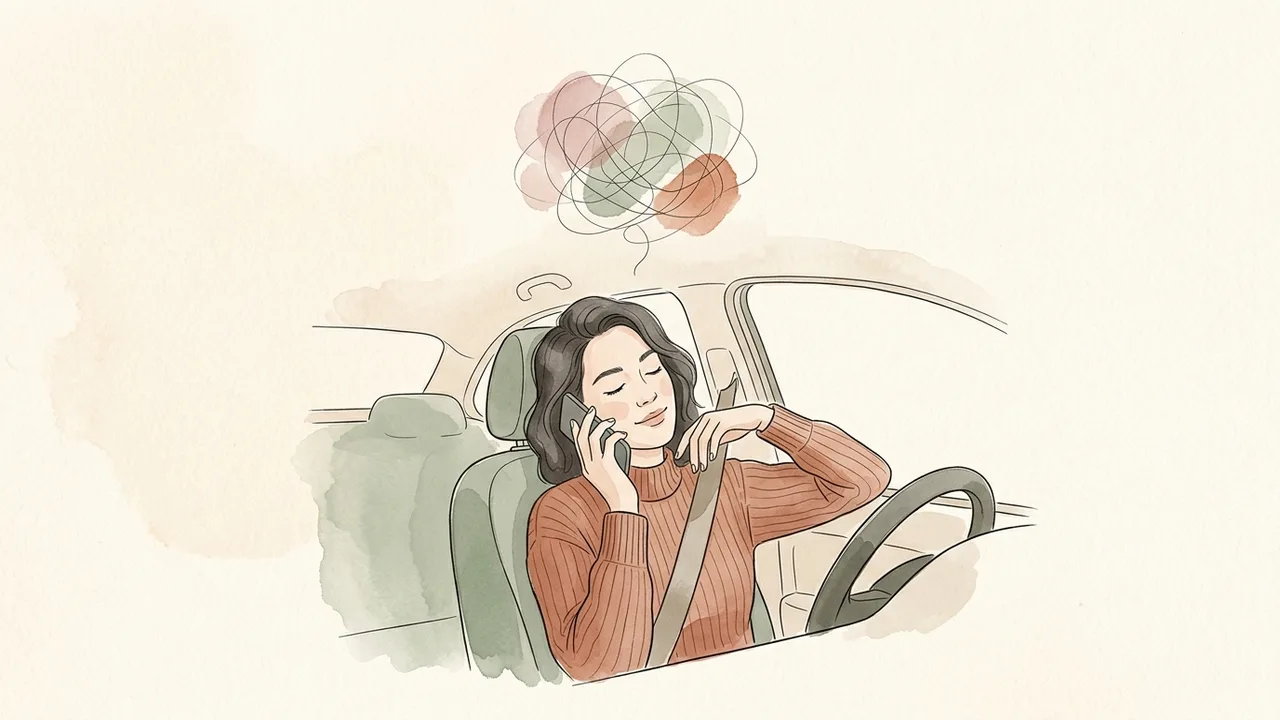
I have a voice note from March I've never listened to all the way through. I recorded it in my car, outside my mom's house, and I don't need to hear it again to know what's on it. My mom's health is getting worse, and there's nothing I can do about it. I said that out loud, and then I cried, and then I stopped the recording.
For years, every note I recorded had a shape. I'd talk until I found the answer or the reframe. If a note didn't end in resolution, I'd record another one until it did. I treated my feelings like bugs. Every one of them had a fix, and my job was to find it before I hit stop.
March broke that. You can't reframe your mom's health. There's no silver lining and no five-step plan. I sat in that car with a feeling that had no exit, and my brain kept offering me tools, and none of them fit.
So I did the only thing left. I said it out loud and I didn't fix it. That was harder than finding solutions, which surprised me. Then I went looking for whether letting a feeling stay broken was a real strategy or just giving up.
The research surprised me too.
Ford and colleagues published a study in 2018 in the Journal of Personality and Social Psychology. They ran three studies on something called emotional acceptance. The name is the definition: letting negative emotions exist without judging them or rushing to change them.
In the first study, they measured how much people habitually accepted their negative emotions, then checked back months later. The people who accepted more had better psychological health, even after controlling for how much negativity they actually felt. They felt the same amount. They just fought it less.
In the second, a lab version, people did a stressful task and some were told to accept whatever they felt while they did it. The acceptance group felt less negative emotion afterward. Not because the task got easier. Because they stopped stacking a second layer of distress on top of the first.
There was a diary study too. On days people accepted their emotions more, they felt better, independent of what actually happened that day.
Here's the part I keep turning over. The pattern in that paper matches the pattern in my car exactly. The first feeling was the bad news. The second feeling was my reaction to it: this shouldn't be happening, I should be handling this better. The research suggests that second layer is the part that does the damage. The bad news was always going to hurt. My refusal to let it hurt was the extra weight.
Ford and Gross followed up in 2019 with a review in Current Directions in Psychological Science, and they gave that second layer a name: emotion beliefs. The belief that negative emotions are harmful, or a sign something's wrong with you. People who hold those beliefs tend to regulate harder, and worse. The belief itself creates the struggle.
I used to believe every bad feeling was an emergency. That belief is why I couldn't sit with the March note. Not the feeling. The belief about the feeling.
So here's what changed, and it's small. When I record something now, I don't always need to get to the answer. I have a new rule: some notes are allowed to end unresolved. The feeling gets said, out loud, and then the recording just stops. No "but." No "at least."
And this is where voice journaling does something writing never did for me.
A written entry wants a conclusion. You write a sentence, then another, and the page pushes you forward until you land somewhere. That's fine for solvable problems. It's torture for unsolvable ones, because you end up manufacturing endings that aren't true. I've written "I'm at peace with this" in a journal when I was very much not at peace. The page needed a final sentence, so I gave it one.
A voice note doesn't need a final sentence. It can end mid-breath. It can end with silence. And I've found that saying an unsolvable feeling out loud, once, with no pressure to resolve it, does something different. It lets the feeling be real without making it a project. You say it, you hear it back. Then you put the phone down. The feeling stays, but it stops being a task.
There's a strange thing that happens with the ones I do play back. When I hear myself say "I can't fix this" in my own voice, it doesn't sound like giving up. It sounds like a fact. And facts are easier to carry than fights.
I don't want to oversell this. Acceptance isn't magic, and it isn't resignation either. It's not "let it go and move on." Some notes are still solvable, and I still solve them. Last week I recorded a work thing and heard myself say the actual problem in two sentences. Fixed it the same day. The unsolvable ones are a different species. They need to be said, and then left alone.
My mom's note is still in my phone. I still haven't listened to the end. But I stopped feeling guilty about that, which is new. The note exists. That's the point of it.
So here's my question. What feeling are you still trying to fix, and what would happen if you just said it out loud, and let the recording end without a solution?